The Art of Disappearing by Ajahn Brahm
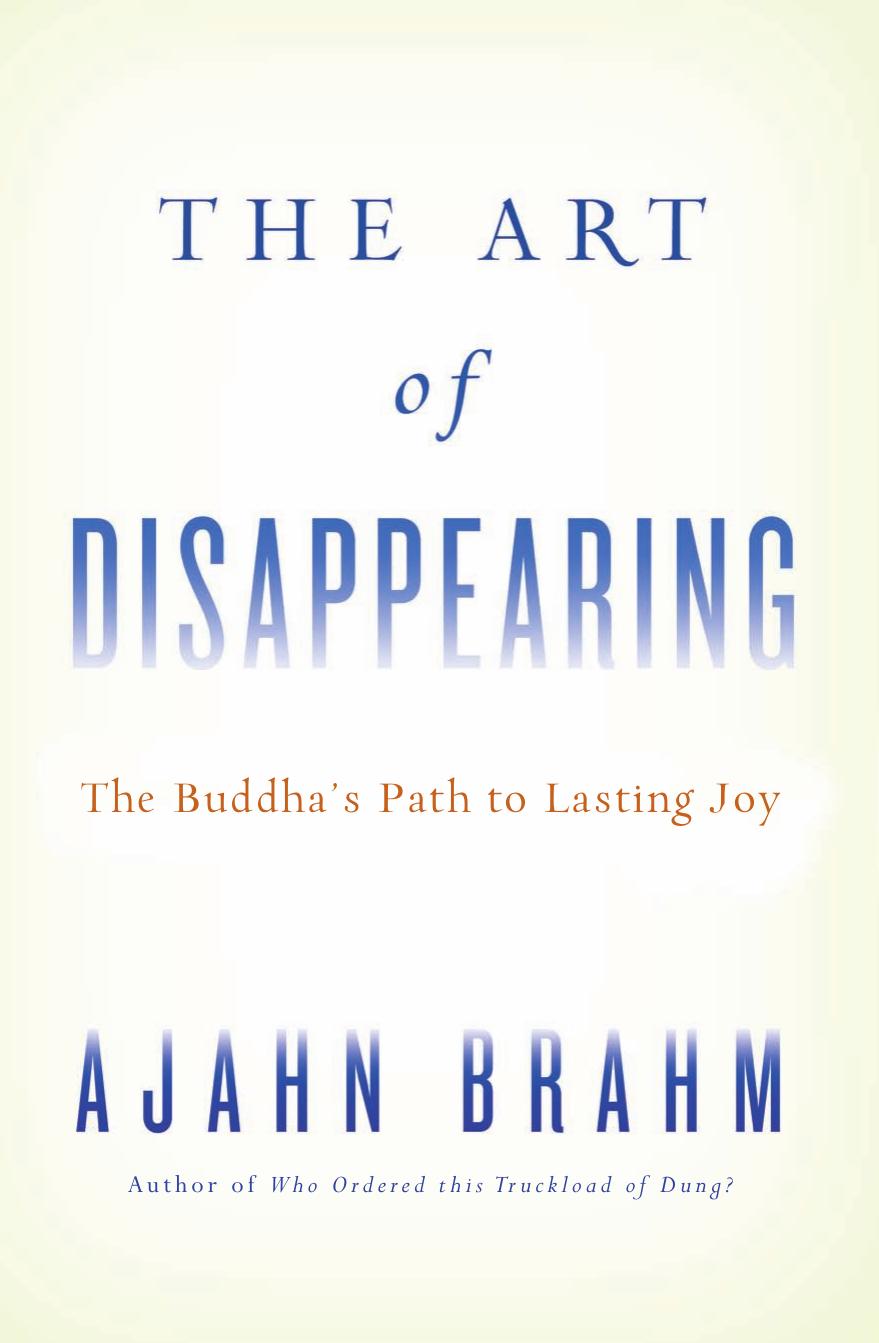
Author:Ajahn Brahm [Brahm, Ajahn]
Language: eng
Format: epub, pdf
Published: 2012-02-18T14:05:34+00:00
Pacification and theInsights that Follow ! 71
Pacifying Sensory Diversity
When you’re ready to go further, the next step is to focus. Why do you have to watch the breath? Why can’t you just stay in the silent present moment and leave it at that? Because of the diversity of the six senses and all their various objects, you are constantly bombarded by the noise of sensory experience. To calm that down, you first have to focus, turning from six senses to just two: the sense of touch (in the form of the breath) and the mind. Eventually you let go of the breath and reduce the focus to just the mind. This focusing of the mind is one of the great discoveries of the Buddha, because it’s a crucial part of the way out of saṃsāra. The focused mind is another rung up the ladder of stillness.
The problem with nonverbal attention in its most undeveloped form is that the mind is still moving. This is because the mind is restless, seeking happiness now here, now there. The mind thinks that the next experience will be interesting or useful. It’s this lack of contentment that drives people’s lives, making them read books and watch movies, making them wander all over the world. What are they searching for? Look carefully and you’ll see that wherever you go, things are essentially the same. The trees are the same and so are people. Why go to see the Great Wall of China? It’s no big deal—walls are just walls. Or you take an expensive ride to the top of the Eiffel Tower. But a view is just a view. Why do people want to do these things? Often it’s just something more to do—and wanting that next thing gives us a sense of who we are. We seek our identity in always going on to the n ext thing.
There’s an old metaphor that describes life as a journey and meditation as the stopping of that journey. By stopping and sitting down somewhere and focusing on the breath, you can overcome the inclination of the mind to always want to go somewhere else. If you’re really watching your breath, you can’t feel any other part of your body. you don’t know whether it’s cold or hot, whether you’ve got an ache in your leg or a pain in your knee—you can’t feel those things anymore. you’re fully focused on the breath going in and out, unaware of anything else whatsoever. you’ve let go of diversity—you’ve pacified that movement of the mind that reaches 72 ! The Art of Disappearing
out to the other senses. In other words, you’ve pacified four of the senses: seeing, hearing, smelling, and tasting. you’ve also pacified most of the sense of touch. All you have left is the breath, and now you’re calming and pacifying that too.
you don’t succeed in this process of pacification by controlling and holding on. I’ve tried that myself and it doesn’t work. If you hold on to
Download
This site does not store any files on its server. We only index and link to content provided by other sites. Please contact the content providers to delete copyright contents if any and email us, we'll remove relevant links or contents immediately.
The Secret Power of Speaking God's Word by Joyce Meyer(3242)
More Language of Letting Go: 366 New Daily Meditations by Melody Beattie(3034)
The Holy Spirit by Billy Graham(2961)
To Light a Sacred Flame by Silver RavenWolf(2828)
Tuesdays With Morrie by Mitch Albom(2767)
The Lost Art of Good Conversation by Sakyong Mipham(2662)
The Traveler's Gift by Andy Andrews(2465)
Kundalini by Gopi Krishna(2188)
A Kingsbury Collection by Karen Kingsbury(2109)
Anxious for Nothing by Max Lucado(1981)
Finding Chika by Mitch Albom(1973)
Angels of God: The Bible, the Church and the Heavenly Hosts by Mike Aquilina(1971)
Angels by Billy Graham(1929)
As a Man Thinketh by James Allen(1908)
The Yoga of Jesus: Understanding the Hidden Teachings of the Gospels by Paramahansa Yogananda(1868)
Curse Tablets and Binding Spells from the Ancient World by Gager John G.;(1865)
Autobiography of a Yogi (Complete Edition) by Yogananda Paramahansa(1829)
Barking to the Choir by Gregory Boyle(1824)
How To Be Born Again by Billy Graham(1789)
